Oracle E-Business Suite
Oracle E-Business Suite supports today’s evolving business models, drives productivity, and meets the demands of the modern mobile user.
Oracle E-Business Suite (EBS) is a complete set of on-premise business applications for managing and automating processes for your enterprise. It is also known as Oracle Enterprise Resource Planning (ERP), Oracle Apps, Oracle Applications, and Oracle Financials on the market. It is a comprehensive suite of integrated, global business applications that provides the following functions:
- A complete, integrated business intelligence portfolio
- An adaptable global business platform
- A customer-focused applications strategy

Oracle E-Business Suite Solutions
We provide Oracle E-Business Suite solutions that support and optimize critical enterprise functions, improve operational control, and deliver stable, integrated system capabilities to support informed decision-making and long-term business objectives. Our solutions include the following:
An Oracle E-Business Suite (EBS) Finance is comprehensive, integrated financial management capabilities, covering General Ledger, Payables, Receivables, Assets, and Cash Management, all built on a unified architecture for consistent data, improved visibility, control, and automated workflows for better decision-making and compliance.
Oracle Order Management (OM) is an end to end order-to-Cash solution within Oracle’s Supply Chain Management (SCM) suite that automates and optimizes the entire order lifecycle, from customer demand capture to fulfillment, helping businesses manage complex orders, improve service, and increase profits through features like omnichannel orchestration, product configuration, dynamic pricing, and integration with planning & inventory system. It centralizes order processing, providing visibility, control, and efficient workflows across various channels and fulfillment systems to ensure timely and accurate delivery.
Oracle Inventory Management is a comprehensive, cloud-based supply chain solution within Oracle Fusion Cloud ERP, offering real-time tracking, control, and optimization of goods across global networks for efficient material flow, reduced costs, and improved customer service by integrating with other SCM apps like Warehouse Management and Order Management. It manages all inventory types, supports automated replenishment, provides deep analytics via dashboards, and helps businesses adapt to disruptions by balancing supply with demand.
Oracle Purchasing is the application for professional buyers that drives operational excellence in Procurement processes. It is a key component of Oracle Advanced Procurement, the integrated suite that dramatically cuts supply management costs. Key Features :
- Professional Buyers Work Center
- Contingent Labor Users
- Multi-Organization Access Control
- Flexible Document Styles
- Tolerance Based Auto-approvals
- Support for Complex Work
Process Process Manufacturing (OPM) Cost Management combines detailed cost-tracking features with flexible analytical tools to help process manufacturers determine their true product costs. OPM Cost Management supports Standard, Actual and Lot types of approaches to calculate costs and create reports to analyze data at the most granular level. Using Oracle Subledger Application, necessary accounting entries are created for all the transaction
Key Benefits :
- Obtain accurate cost information and the necessary tools to analyze cost data using several cost types simultaneously
- Use OPM Cost Management in conjunction with Oracle Subledger Accounting to flexibly choose the right accounts for your business and create journal entries for material and resource transactions
Oracle Discrete Manufacturing provides a comprehensive suite for managing complex production, featuring Work in Process (WIP), MES (Manufacturing Execution System), Quality Management, and Cost Management, enabling real-time tracking, genealogy, lot/serial control, mobile shop floor access, and detailed analytics for efficiency and quality in assemble-to-order, project-based, or mixed-mode environments
Oracle Enterprise Asset Management (eAM) is a part of Oracle’s E-Business Suite, providing organizations with the tools to create and implement maintenance procedures for both assets and rebuildable inventory items. Maintenance procedures are an integral part of an organization’s complete asset lifecycle management strategy, enabling an organization to optimize asset utilization. eAM enables users to optimally plan and schedule maintenance activities with minimal disruption to an organization’s operations or production. Importantly, it improves resource efficiency, enhances maintenance quality, tracks work history, and records all maintenance costs. eAM enables an organization to do the following:
Oracle E-Business Suite Solutions
We provide Oracle E-Business Suite solutions that support and optimize critical enterprise functions, improve operational control, and deliver stable, integrated system capabilities to support informed decision-making and long-term business objectives. Our solutions include the following:
Oracle Financial
An Oracle E-Business Suite (EBS) Finance is comprehensive, integrated financial management capabilities, covering General Ledger, Payables, Receivables, Assets, and Cash Management, all built on a unified architecture for consistent data, improved visibility, control, and automated workflows for better decision-making and compliance.
- General Ledger (GL): Centralized accounting, period closing, consolidation, multi-currency, reporting.
- Accounts Payable (AP): Invoice processing, automated payments, PO matching, tax handling, supplier collaboration (i-Supplier Portal)
- Accounts Receivable (AR): Customer invoicing, payment processing, collections (i-Receivables, Advanced Collections), credit management
- Fixed Assets (FA): Asset lifecycle management (creation, depreciation, disposal)
- Cash Management (CE): Bank reconciliation, cash flow forecasting

Oracle Order Management
Oracle Order Management (OM) is an end to end order-to-Cash solution within Oracle’s Supply Chain Management (SCM) suite that automates and optimizes the entire order lifecycle, from customer demand capture to fulfillment, helping businesses manage complex orders, improve service, and increase profits through features like omnichannel orchestration, product configuration, dynamic pricing, and integration with planning & inventory system. It centralizes order processing, providing visibility, control, and efficient workflows across various channels and fulfillment systems to ensure timely and accurate delivery.
Key features & Capabilities :
- Order Capture & Processing: Gathers orders from multiple channels (online, sales reps) and standardizes them
- Order Orchestration: Manages complex workflows, configuring and routing orders across different systems for fulfillment.
- Global Order Promising: Provides accurate delivery dates by checking real-time inventory and supply.
- Product Configuration: Simplifies complex product and service configurations.
- Pricing & Revenue Management: Supports strategic pricing and revenue management by channel.
- Integration: Seamlessly connects with other Oracle modules like Supply Planning, Inventory, and Finance for a unified process.
- Fulfillment Monitoring: Offers centralized visibility into order status, bottlenecks, and exceptions.
Oracle Inventory Management
Oracle Inventory Management is a comprehensive, cloud-based supply chain solution within Oracle Fusion Cloud ERP, offering real-time tracking, control, and optimization of goods across global networks for efficient material flow, reduced costs, and improved customer service by integrating with other SCM apps like Warehouse Management and Order Management. It manages all inventory types, supports automated replenishment, provides deep analytics via dashboards, and helps businesses adapt to disruptions by balancing supply with demand.
Key features & Capabilities :
- Real-time Visibility: Track stock levels, movements, and transactions across multiple locations.
- Stock Management: Control inventory in all stages, from raw materials to finished goods.
- Inventory Planning: Optimize stocking levels, automate replenishment, and forecast needs.
- Integration: Seamlessly connects with Purchasing, Order Management, Manufacturing, and Finance.
- Analytics & Automation: Uses dashboards and AI for proactive decision-making and process automation.
Oracle Purchasing
Oracle Purchasing is the application for professional buyers that drives operational excellence in Procurement processes. It is a key component of Oracle Advanced Procurement, the integrated suite that dramatically cuts supply management costs.
Key Features :
- Professional Buyers Work Center
- Contingent Labor Users
- Multi-Organization Access Control
- Flexible Document Styles
- Tolerance Based Auto-approvals
- Support for Complex Work
Oracle Process Manufacturing
Process Process Manufacturing (OPM) Cost Management combines detailed cost-tracking features with flexible analytical tools to help process
manufacturers determine their true product costs. OPM Cost Management supports Standard, Actual and Lot types of approaches to calculate costs and create reports to analyze data at the most granular level. Using Oracle Subledger Application, necessary accounting entries are created for all the transaction
Key Benefits :
- Obtain accurate cost information and the necessary tools to analyze cost data using several cost types simultaneously
- Use OPM Cost Management in conjunction with Oracle Subledger Accounting to flexibly choose the right accounts for your business and create journal entries for material and resource transactions
Oracle Discrete Manufacturing
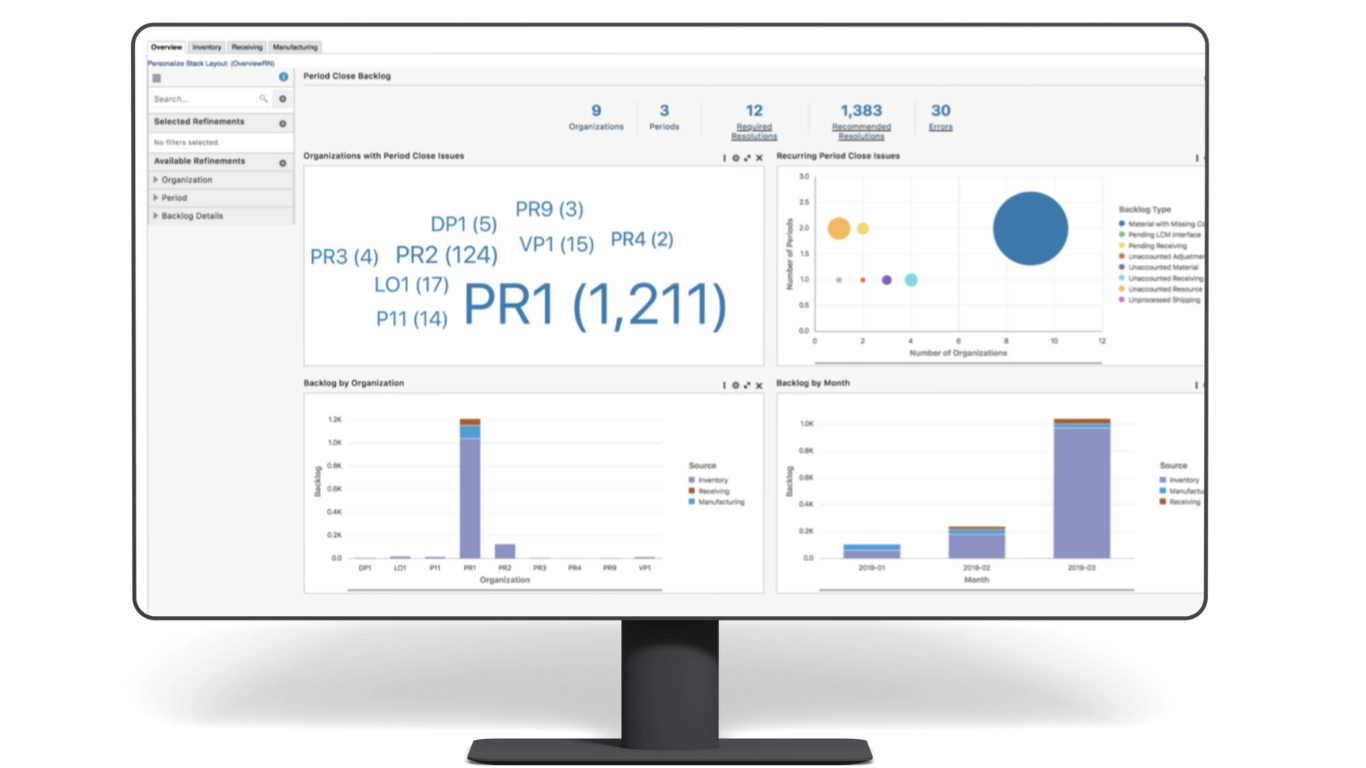
Oracle Discrete Manufacturing provides a comprehensive suite for managing complex production, featuring Work in Process (WIP), MES (Manufacturing Execution System), Quality Management, and Cost Management, enabling real-time tracking, genealogy, lot/serial control, mobile shop floor access, and detailed analytics for efficiency and quality in assemble-to-order, project-based, or mixed-mode environments
Core Components & Features :
- Work in Process (WIP): The foundation for production management, offering complete job management, quality support, and traceability (lot/serial).
- Manufacturing Execution System (MES): Provides a single operator interface (MES Workstation) for transactions, instructions, and dispatch lists, with a Supervisor Workbench for monitoring progress and resolving issues.
- Quality Management: Collects quality data during transactions, tracks rejections, and provides genealogy for detailed traceability.
- Cost Management: Supports various costing methods (standard, average, FIFO/LIFO) and provides analytics for product profitability and inventory valuation.
- Discrete Manufacturing Command Center: Offers dashboards with real-time metrics (job status, shortages, scrap) and drill-down capabilities for operational insight.
Oracle Asset Maintenance
Oracle Enterprise Asset Management (eAM) is a part of Oracle’s E-Business Suite, providing organizations with the tools to create and implement maintenance procedures for both assets and rebuildable inventory items. Maintenance procedures are an integral part of an organization’s complete asset lifecycle management strategy, enabling an organization to optimize asset utilization. eAM enables users to optimally plan and schedule maintenance activities with minimal disruption to an organization’s operations or production. Importantly, it improves resource efficiency, enhances maintenance quality, tracks work history, and records all maintenance costs. eAM enables an organization to do the following:
- Asset Lifecycle Management: Manage assets from design/acquisition through service and disposal, ensuring compliance and best practices.
- Work Management : Plan, schedule, and track maintenance work orders, coordinating with production schedules to minimize disruption.
- Preventive Maintenance : Implement condition-based maintenance strategies using meters, quality plans, and performance monitoring.
- Cost & History Tracking: Record all maintenance costs and work history at the asset level for better performance analysis.
- Integration: Seamlessly connects with other EBS modules like Financials, Inventory, and Projects for a unified view.
- Self-Service: Allows non-maintenance staff to submit and track maintenance requests.